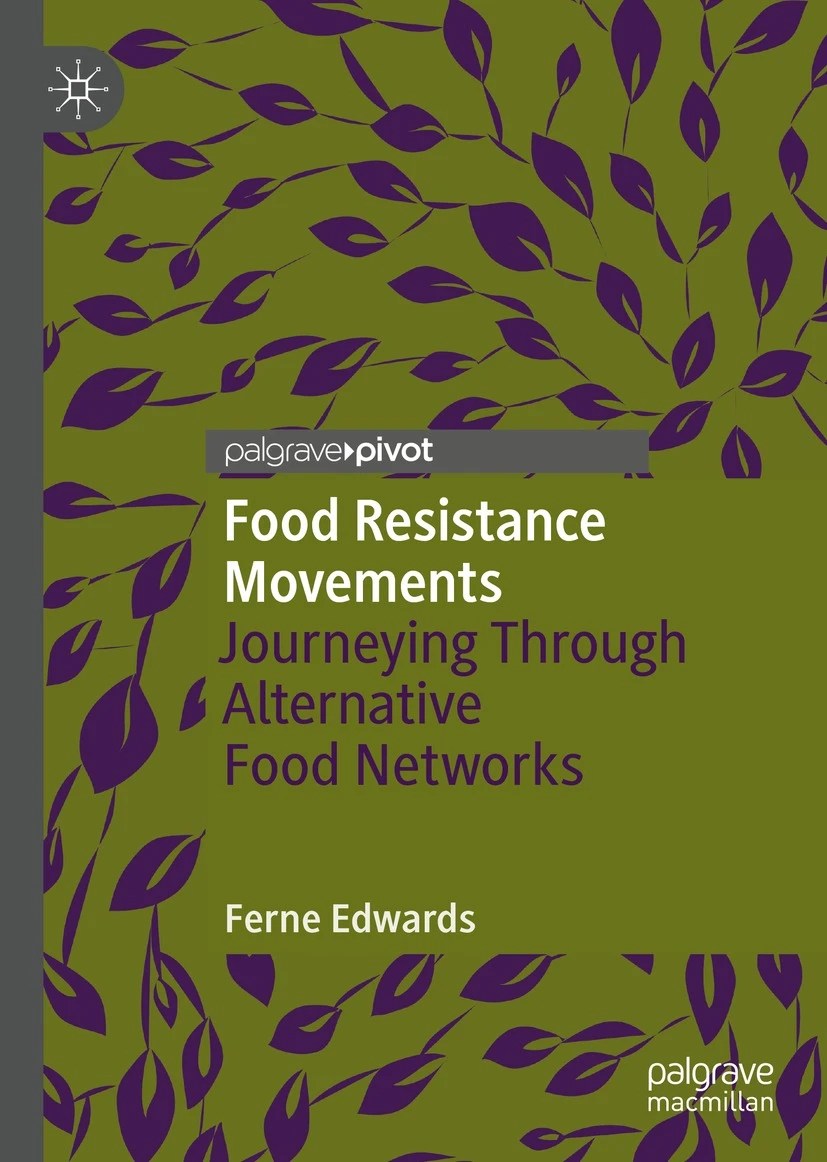
My new book, Food Resistance Movements: Journeying through Alternative Food Networks, draws on key aspects, learnings and queries arising from ethnographies of three international food resistance examples: from the beginning of the food waste movement in Melbourne, Australia, to the emergence of the food sovereignty movement in cities throughout Venezuela, to the mature politicised autonomous food spaces of Catalonia, Spain. Representing almost two decades of grounded research, I pull together insights from these case studies to ask, what have we achieved so far and how can this help determine where next to go?
The book has received kind praise from my peers. They write:
Ferne Edwards has spent years living and researching and eating with visionaries of the future of food. Across three continents, her honest, rigorous, and thought-provoking ethnography uncovers the promise, and the dangers, of some blueprints for food sovereignty. We ignore those lessons at our peril.
— Raj Patel, Stuffed and Starved (2008), Research Professor, The University of Texas at Austin, USA
The risks and problems associated with globalised food systems are becoming abundantly clear, so too is the need for credible alternatives. This punchy and accessible volume brings much-needed clarity to the questions of what resistance looks like and how it might facilitate widespread change. With a finely honed ethnographic sensibility, Ferne Edwards explores an impressive range of urban food movements – foregrounding the experiences of participants and the lessons that can be learnt. At once theoretically sophisticated and politically astute, Food Resistance Movements breathes new life into scholarly and activist perspectives on Alternative Food Networks.
— Professor David M. Evans, co-editor of Waste Matters: New Perspectives on Food and Society (2013), University of Bristol, UK
This volume is a lively and important contribution to understanding global movements for food justice. Grounded in years of ethnographic research on “freegan” strategies to counter food waste in Australia, food sovereignty efforts in urban Venezuela, and autonomous food spaces in Barcelona, it provocatively uncovers the successes and failures of individual and collective tactics to democratize foodways. It will be essential reading for scholars, students and activists interested in forging fair and sustainable food systems.
— Carole Counihan, co-editor of Food Activism: Agency, Democracy and Economy (2013)
The process of devising and implementing more sustainable and participatory alternatives to the mainstream food system takes many diverse forms and frequently involves acts of defiance and resistance to the status quo. That growing numbers of people around the world are engaging in such acts reveals the desire to revitalise our relationship to food, to each other and to the planet. Ferne Edwards brings us to the heart of three very different kinds of resistance in the cities of Melbourne, Caracas, and Barcelona. Drawing upon extensive fieldwork the book reveals the very concrete challenges, political significance, and potentially emancipatory character of these different initiatives. This is a powerful narrative that will offer a source of inspiration for many.
— Colin Sage, Independent Research Scholar
Ferne Edwards’ Food Resistance Movements is a timely, deep ethnography of eco-social resistance movements that explores the power of experimentation in the creation of new urban food systems. This book produces an incredibly valuable multi-scaled analysis of urban food movements across three continents, showing us the lived struggles of what it means to create and experiment with doing food differently in post- and anti-capitalist food spaces. More now than ever, we need to learn from and apply the lessons from this book to produce different and more equal food futures in the cities in which we labour to live and thrive.
— Michael Goodman, Professor of Geography, Department of Geography and Environmental Science, Global Development Research Division, University of Reading, UK
This concise text gives an unflinching state-of-the art survey of popular resistance to the prevailing global-mass-market industrial food system, backed up with three excellent ethnographic case studies. A must-read for those interested in and teaching about alternative food systems.
— Richard Wilk, Open Anthropology Institute andIndiana University
This is a book which is very timely in relation to increasing concerns about food distribution and food waste ― in connection with global warming and the war in Ukraine. These problems are not going away but will intensify, and this is an excellent resource regarding some of the approaches that are being tried in different parts of the world.
— Dr Terrence Leahy, University of Newcastle, Australia
To purchase a copy visit the Routledge website.
If you are interested in reviewing the book (and receiving a free text), please contact me at f.edwards@surrey.ac.uk.
 Ferne Edwards